Lipce school
The PeasantsLipce school becomes a contested object through which villagers confront the authorities’ power to set educational policy, impose taxes, and demand that children learn in another language. The school is presented as a genuine need, but its proposed form makes approval inseparable from questions of cost, trust, and local authority. Its establishment is officially announced after a divisive assembly, even as the villagers’ protests expose how little control they have over the decision.
Proposal and local need
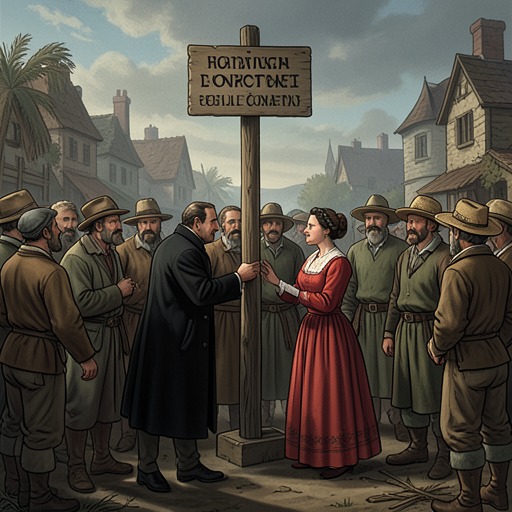
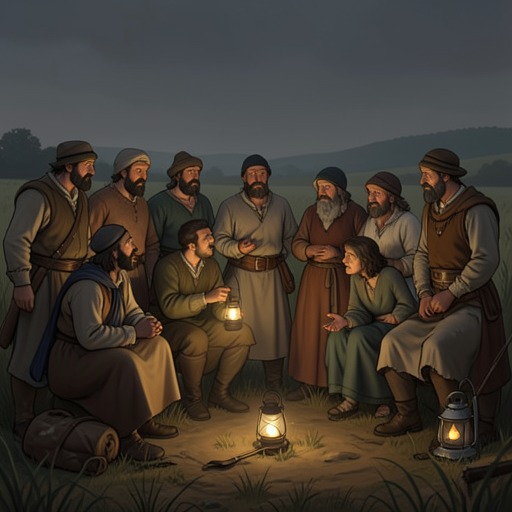
The school proposal enters discussion when Rocho tells the young villagers that the Prefect expects Lipce to assemble within two weeks to approve one. The news prompts disagreement about who should decide: Płoszka dismisses the matter as something for their fathers, while Grzela rebukes the younger men for leaving village affairs to others. Antek Boryna gives the debate its central distinction. Lipce needs a school, he says in substance, but should not approve even a grosz for the Prefect’s school. Rocho supports him and warns against accepting the proposal uncritically. Their position is not a rejection of learning; it separates the village’s need for education from the authorities’ terms for providing it.
The plan is later read aloud by the Notary. The proposed school is to serve not only Lipce but also Modlica, Przyłęk, Rzepki, and smaller villages. The Notary describes the project as an act of official generosity and lists the required expenses: a plot with a field, construction, ongoing maintenance, and a teacher. To cover them, the authorities require an additional tax of twenty kopecks per morgen. The Prefect, the Notary reports, will permit construction to begin that year if the tax is approved, with children expected to attend the following autumn. These are promises about a proposed schedule, not evidence that the building is completed or classes begin.
A decision burdened by poverty and distrust
The school tax falls on villagers already short of money. During the harsh preharvest season, some lack even enough for salt, and unpaid taxes and other dues weigh on households that hope to settle accounts after harvest or at the next fair. The new charge is therefore not an abstract contribution: each person must consider it alongside immediate household needs. When the Notary finishes his presentation, the villagers sit hunched and silent, as if already carrying the weight of the proposed tax.
Distrust also shapes the debate. Before the assembly, the Notary privately pressures farmers over taxes and court-building dues, asks for goods, and makes promises while threatening consequences. At the school meeting, he warns that refusing approval could anger the Prefect and endanger the villagers’ goodwill agreement with the Squire over the wood. Płoszka answers that the agreement is being made in good faith. The warning turns a school vote into a test of whether official pressure can make villagers trade one local interest for another. When the Notary calls for someone to run an errand to the manor, no one moves; a villager answers that they did not come to carry messages. That refusal, modest but public, marks a limit on the deference expected of them.
Protest over language and authority
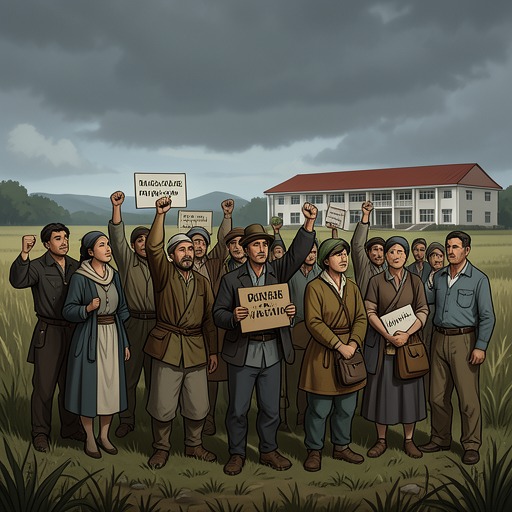
The assembly’s dispute is not only about cost. Antek had already argued that Lipce needed a school but should not pay for the Prefect’s version; at the meeting, Grzela and those with him reject the proposal outright, and the opposition grows louder. When the Prefect appears, a speaker insists that learning in their own school must take place in their own tongue. The demand makes language a matter of local dignity and control, not merely a practical detail of instruction.
The Voyt calls for the gendarmes when the protest continues. The crowd closes around them, with someone warning that three hundred people are present and that the gendarmes should not lay a finger on anyone. The villagers then part to let the officers pass, but surge after them in front of the Prefect, angry and shaking their fists. One cry gives concise form to their objection: “Every creature has its own tongue, but only we are ordered to use another’s.” The school thus becomes the means through which an imposed language enters village life, and opposition to it gathers force in a public, collective setting.
The vote and official outcome
Despite the earlier refusal and the majority’s apparent inclination to vote against the school, the Notary records the final tally as two hundred votes for and eighty against. Grzela’s group protests that the count has been manipulated and calls for another vote. The narrative records their accusation, not independent proof of fraud. Before the dispute can be resolved, the Squire’s carriage arrives. After reading a letter delivered by his attendant, the Prefect announces that there will be a school in Lipce. The villagers fall silent; the Prefect signs papers, enters his carriage, and leaves.
The official declaration settles the immediate question in the authorities’ favor, while leaving the villagers’ misgivings and the contested count in view. Approval has not been presented as an unambiguous expression of consent: the meeting includes opposition to the tax, resistance to the language requirement, pressure linked to the forest agreement, and a challenge to the tally. The proposed school’s significance lies in this tension. It answers a need the villagers themselves acknowledge, yet its financing and terms are determined through an administrative process that they distrust and cannot finally prevent.